SORRY! I have been incredibly busy. BUT. As my Bri 2.0 project is over (it's been over since August... oops) I'll resume political blogging on my main website because it just makes more sense to have everything together. Thanks for understanding :)
-Bri
Monday, February 7, 2011


Thursday, August 12, 2010
Fred Phelps can kiss our collective butts

I'm sure by now everyone has heard about Prop 8 being ruled unconstitutional in California. Judge Vaughan Walker ruled that "the freedom to marry is a fundamental right protected under the due process clause...Never has the state inquired into procreative capacity or intent before issuing a marriage license; indeed, a marriage license is more than a license to have procreative sexual intercourse...
"The evidence shows that the movement of marriage away from a gendered institution and toward an institution free from state-mandated gender roles reflects an evolution in the understanding of gender rather than a change in marriage. The evidence did not show any historical purpose for excluding same-sex couples from marriage, as states have never required spouses to have an ability or willingness to procreate in order to marry...
"Plaintiffs do not seek recognition of a new right. To characterize plaintiffs’ objective as “the right to same-sex marriage” would suggest that plaintiffs seek something different from what opposite-sex couples across the state enjoy —— namely, marriage. Rather, plaintiffs ask California to recognize their relationships for what they are: marriages."
BAM! GO JUDGE WALKER!
I think that these sentiments should demonstrate why we should just stop arguing already. Seriously. Gay people are people, straight people are also people. So why can't every person get married? It's ridiculous.
I don't care what your religion says. I really don't. You know why? It's not because I'm a heathen, and it's not because I don't respect your beliefs. It's because it doesn't matter.
I'm not saying it doesn't matter to you, or the people who belong to your church, or whatever. I'm saying it doesn't matter in the realm of law. Your religion, while it may bring you great comfort, has no place in politics. I'm sorry that your religion doesn't like gay people. I truly am. But please, don't use that against us.
What if my religion said that eating the flesh of animals is immoral, and I started lobbying to shut down every single meat production entity in the country? What if I spent millions of dollars campaigning and screaming that people who eat meat are all going to hell and should not be allowed to have rights under the law?
You would think I was crazy and lock me up.
Why is it so difficult to understand that
A. Homosexuality is not only a biological phenomenon, it also occurs in nature, and
B. We live in a country that grants freedom of religion, thus in turn meaning that we live in a country where your religious beliefs mean nothing in a court of law when your religious beliefs aim at taking away rights from other people on the grounds of they are your religious beliefs.
The thing about the Prop 8 trial is that only an idiot would have ruled in another direction. Seriously, other than the religious arguments, what else do the opponents of this issue have? Right. Nothing.
I can't believe that our so-called "advanced society" hasn't yet realized that we're acting like stubborn children.
Sunday, May 16, 2010
Isn't Racism Fun?
I know that I'm a bit late for this bandwagon, but I haven't whined about politics in a while. Even though school is over and this is no longer an assignment, I hope to update this lovely blog offshoot from time to time. Who knows, maybe I'll integrate it better with my actual website eventually!
Back to my intended rant topic however, I want to talk about Arizona's fun new immigration law. I was bored enough today to download the full, 19 page text of the law, and here are some especially fun bits that I found.
"FOR ANY LAWFUL CONTACT MADE BY A LAW ENFORCEMENT OFFICIAL OR A LAW ENFORCEMENT AGENCY OF THIS STATE OR A LAW ENFORCEMENT OFFICIAL OR A LAW ENFORCEMENT AGENCY OF A COUNTY, CITY, TOWN OR OTHER POLITICAL SUBDIVISION OF THIS STATE WHERE REASONABLE SUSPICION EXISTS THAT THE PERSON IS AN ALIEN WHO IS UNLAWFULLY PRESENT IN THE UNITED STATES, A REASONABLE ATTEMPT SHALL BE MADE, WHEN PRACTICABLE, TO DETERMINE THE IMMIGRATION STATUS OF THE PERSON, EXCEPT IF THE DETERMINATION MAY HINDER OR OBSTRUCT AN INVESTIGATION. ANY PERSON WHO IS ARRESTED SHALL HAVE THE PERSON'S IMMIGRATION STATUS DETERMINED BEFORE THE PERSON IS RELEASED."
To sum this bit up, Arizona law enforcers are basically supposed to arrest anyone who they believe looks like an illegal alien. And before these "reasonably suspicious" persons are released, their immigration status has to be verified. More on this later.
"IT IS UNLAWFUL FOR A PERSON WHO IS UNLAWFULLY PRESENT IN THE UNITED STATES AND WHO IS AN UNAUTHORIZED ALIEN TO KNOWINGLY APPLY FOR WORK, SOLICIT WORK IN A PUBLIC PLACE OR PERFORM WORK AS AN EMPLOYEE OR INDEPENDENT CONTRACTOR IN THIS STATE."
I just thought this was funny, since obviously this very specific law is going to stop people. "Hm. I'm unlawfully in this country. I should NOT try to get a job, even though my family is starving and I wouldn't be in this country in the first place if I didn't want a job."
The bill goes on to discuss the different ways that it is editing current laws, including ones about employment and transporting illegals, but there aren't any more fun quotes.
So back to that first quote, which is the most important in this blog. There has been a lot of talk thrown around regarding "racial profiling", and let's be honest, that's exactly what this law is condoning. Think about this for a second, what gives a police officer reasonable suspicion for believing someone is an illegal immigrant? How does one look illegal? Does one drive carefully so as not to be pulled over? Does one constantly check over one's shoulders for border patrol? Does one have a tattoo reading "I'm in this country illegally! Na-na-na!"
No. All one has to do is look Hispanic, and police officers are justified under this law to arrest you.
This brings up an interesting paradox, however. Not all illegal immigrants are from Mexico, although they are the majority. According to the Urban Institute, "between 65,000 and 75,000 undocumented Canadians currently live in the United States." And according to the Department of Homeland Security, 280,000 people from India and 230,000 people from China are in this country illegally. Does that mean that police officers are justified in pulling over anyone who looks Chinese or Indian? Of course not!
Unfortunately, just from visual cues, there is really nothing that sets illegal immigrants apart from the rest of society. This law is inherently racist, and it's clearly a violation of our freedom. Illegal immigration needs to be quelled, or at least dealt with, but this law is not the way to do it. I can only hope that soon, someone, somewhere will realize just how awful this law is and destroy it before it goes too much further.
1984, anyone?
Wednesday, March 31, 2010
I'm Telling

A couple months ago I posted a scathing discussion regarding the "Don't Ask, Don't Tell" policy. And apparently, there have been some updates regarding this issue.
According to Time Magazine, "The Pentagon took a giant step toward integrating openly gay men and women into the U.S. military on Thursday. No, it didn't repeal 1993's "Don't ask, don't tell" law — only Congress can do that. But it did something that could be almost as important: it eased the enforcement of that law by loosening the regulations that have been used to snare 13,500 gays — and boot them out of uniform — since 1994."
Good for the Obama administration. Although, seeing as the policy was created by an executive order, I don't see why it can't be repealed the same way.
Eh. What do I know?
Monday, March 29, 2010
Nobody's Perfect

You know what is starting to get on my nerves? This statement:
"I know the health care bill isn't perfect, but it's a step in the right direction."
WRONG WRONG WRONG.
First off, the health "care" bill is mostly about health insurance reform; namely, getting it to everyone. Because everyone already has health care- you're not allowed to be denied a life threatening surgery.
Second off, something that isn't perfect isn't a step in the right direction. That's a logical fallacy. A step in the right direction would be perfect, but it would only have a small impact. If something is being put into policy that isn't perfect, then isn't it a step backwards? Wouldn't it just cause more problems, because now not only do we have to make more policy to complete the steps, but we also have to correct the policy we just passed! That doesn't make sense.
Third off, and finally, that's not a reason to support something. That's a cop-out statement that means "I've heard stuff from both sides, but I'm generally a liberal, so I should probably be in support of it. But I want to seem moderate, so I'll concede that there's some stuff wrong with it."
Don't be a zombie, guys. Come on.
Sunday, March 28, 2010
Green Jobs

Yeah, yeah. There's been a break in blog posting. But I got my wisdom teeth out last week, so I've been loopy with pain medication. Whatever.
Green jobs make sense. I don't know why anyone would think otherwise. Not only does it promote clean energy- which will sustain us for a lot longer than fossil fuels- but also the creation of jobs, many of which could be considered skilled.
Obviously, things aren't going to change immediately. It's ridiculous to assume that. Of course we can't just raise the masses magically out of unemployment, because there's things to work out, as this economic downturn wasn't exactly planned, but they will be raised.
And look, the economy isn't actually that bad. During the Great Depression, unemployment was 25% and higher. Today, it's like 12-15%. It's bad, yes, but I don't see a Dust Bowl anywhere.
Friday, March 19, 2010
In Theory
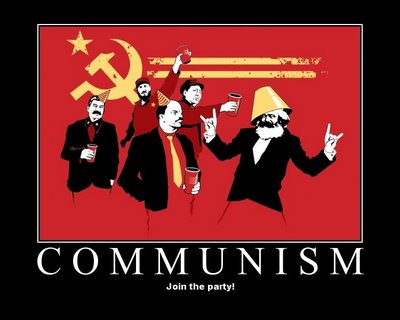
Communism: a social structure in which classes are abolished and property is commonly controlled, as well as a political philosophy and social movement that advocates and aims to create such a society.
It's not a secret that most of my friends are very, very liberal. One is even pending membership in the Socialist party. And oftentimes, we get into deep political ideology discussions, in which I hear this quite often.
"Yeah, communism is good in theory, but not in practice."
I don't just hear this from my friends, however. This argument defending the ideology is quite common. But I have news for you: it's untrue.
Communism is neither good in theory nor in practice, and I'm here to tell you why.
First, there's the issue of innovation being doomed to halt. I'm sure you're all aware of the dark ages. "Later historians expanded the term [Dark Ages] to refer to the transitional period between Roman times and the High Middle Ages, including not only the lack of Latin literature, but also a lack of contemporary written history, general demographic decline, limited building activity and material cultural achievements in general. Popular culture has further expanded on the term as a vehicle to depict the Middle Ages as a time of backwardness, extending its pejorative use and expanding its scope."- Joseph Tainter
How does this relate to Communism? Patience, please. In Communism, regardless of your skill level or occupation, you are paid the same amount as everyone else. That's one of the big changes in the system to eliminate socioeconomic classes. However, all this would do is murder any kind of competitive drive that exists within workers. If there are no rewards for doing a good job or inventing something or having a better idea, then there is no reason anyone will do any of those things. Let's face it, competition creates innovation, because without some sort of reward, why bother? If we accept Communism, then we accept responsibility for creating another Dark Age, where we move backwards instead of forwards.
Second, there's the idea of complete government control. In the Communist system, the government is in charge of everything. Whatever they want, they can do. Civil rights? Forgetaboutit. The wishes of the few override the wishes and the needs of the whole, and that doesn't seem like a sound system.
I sort of see where my friends and others like them. Communism would eliminate classes, because classes are BAD! Communism gives everyone the same opportunities, and opportunities are GOOD!
Unfortunately, I have to disagree. Social classes may seem bad, but without them, again, competition wouldn't exist. People of lower classes are motivated to work hard in order to earn a position higher up, even if there's only a very low probability it will happen. And people of higher classes have earned- through their own hard work or the hard work of a family member- their status. We shouldn't punish someone for being successful. Also, although communism seems to allocate the same opportunities to everyone, it's an illusion. What communism does is chooses the opportunities it wants to afford its citizens and then limits its citizens to those few things. Capitalism affords the same opportunities to everyone, even though the success rates aren't always even, but communism limits both success and opportunity.
As far as I can tell, there's nothing good about the idea or the practice of Communism.
Wednesday, March 17, 2010
PropH8 Update

Back in 2008, if anyone remembers, California legalized gay marriage and found itself with an influx of couples traveling there to finally exchange their vows. But mere months later, voters ratified Proposition 8, which banned it once again.
Now, a heated trial has commenced over the constitutionality of the act, which effectively defines marriage as between a man and a woman.
According to the Associated Press, "The trial — the first in federal court to examine if the U.S. Constitution prevents states from outlawing same-sex marriage — has been on hiatus since late January, when Walker said he wanted to review the evidence before scheduling closing arguments."
There has been much controversy over the trial, even amidst the already controversial issue of gay marriage. Most experts agree that regardless of the ruling in the California Supreme Court, the debate of gay marriage will soon reach the federal circuits, and the federal Supreme Court.
Matt Coles of the Huffington Post had a few thoughts on possible Supreme Court rulings. "First, you can take a pure constitutional law perspective. As I said before, most constitutional lawyers think that discrimination based on sexual orientation should not be treated as generally constitutional. If the Court were to agree, it would be unlikely to uphold the marriage exclusions. But it’s not as if this is the only way to read the Constitution. There is a constitutional theory that says that all discrimination except discrimination based on race, maybe alienage, and sex should be treated as generally constitutional (the idea is that the 14th Amendment, which guarantees equal protection, was really about race; most of the folks who subscribe to this view wouldn’t include sex either, but that constitutional ship sailed a long time ago). For the last 30 years or so, this narrow view of what kind of discrimination the federal Constitution prohibits has been doing better in the Supreme Court than the broader view. But there are times when the Court seems to be trying to chart a somewhat broader course."
The 14th Amendment's text is this: "All persons born or naturalized in the United States, and subject to the jurisdiction thereof, are citizens of the United States and of the State wherein they reside. No State shall make or enforce any law which shall abridge the privileges or immunities of citizens of the United States; nor shall any State deprive any person of life, liberty, or property, without due process of law; nor deny to any person within its jurisdiction the equal protection of the laws."
Now, from where I sit, it looks as though Prop8, and other laws like it, are clearly abridging the privileges of US citizens and depriving them of equal protection of the laws. I don't know about the Supreme Court, but it seems to me that this issue is pretty clear.
Tuesday, March 16, 2010
Libert(arianism)y

To most of the people I know, I am considered liberal. In Gov, I'm considered a moderate, or sometimes even a republican. But none of these things is true.
Alright, so maybe "moderate" is a bit better description, but it still doesn't encompass the entirety of my viewpoints. It's too vague.
According to the Libertarian Party website, libertarianism asserts that "support maximum liberty in both personal and economic matters. They advocate a much smaller government; one that is limited to protecting individuals from coercion and violence. Libertarians tend to embrace individual responsibility, oppose government bureaucracy and taxes, promote private charity, tolerate diverse lifestyles, support the free market, and defend civil liberties."
Essentially, being a libertarian means you're fiscally conservative and socially liberal. I support both capitalism and equality of marriage. I support both the free market and pro-choice policies.
I consider the libertarian belief to be based solely in logic. Something is considered logical when, according to Princeton University, it is "marked by an orderly, logical, and aesthetically consistent relation of parts", or when it is reasonable, which, to clarify, is to be fair and showing sound judgment.
The opposite of a free market society, which is something libertarians support, is a socialist society. Socialism is "an economic system that has transcended commodity production and wage labor, where economic activity is carried out to maximize use-value as opposed to exchange-value, including in its definition a corresponding change in social and economic relations; such as the organization of economic institutions and resource allocation;often implying advocacy for a method of compensation based on the amount of labor expended."
Basically, socialism is paying everyone the same amount of money regardless of their skill level or qualifications.
Tell me, how is this a reasonable system? Logically, a business would want the best employees, and a successful CEO deserves the money his hard work has earned. Of course, not everyone in a capitalist or free market society deserves their money, but a lot less people are undeserving under this system than there would be in a socialist or communist system.
Moving on. On the social side, I'll pick gay marriage as my issue. Logically, allowing two men or two women to be legally married hurts no one, changes nothing about the social fabric of the country (since there are gay couples living openly everywhere), and destroys no sanctity of the institution. (My sanctity argument can be paraphrased as such: SEPARATION OF CHURCH AND STATE)
Libertarianism fights for what is logical and reasonable in society, and I hope that someday its political party can make it into the bid presidential debates.
Thursday, March 4, 2010
This is the end

Since this is my last blog for the quarter, I figured I'd look into my political archives to see what to talk about. And to my nostalgic glee, I found an old debate case about the French healthcare system.
French healthcare is championed as one of the forerunners of affordable, universal healthcare. But there are some significant problems with this assessment.
In the French system, it is more expensive to see a specialist than a general practitioner, it is more expensive to have a home visit, and even more expensive to see a doctor at night, on Sundays, or on public holidays. The cost of the French system overall is boasted to be cheaper by half than the United States, but France also has 240,939,860 less people than the United States. That's a lot less people to cover. Also, if their healthcare spending continues at this rate, France will be 70 billion euros in debt by the end of 2020.
That doesn't sound like much fun. Now, the debate case I'm pulling bits of information from digresses into a discussion of the Japanese health care system, which it believes is much more efficient. Let's have a look, shall we?
In Japan, universal health coverage is divided into two categories; National Health Insurance and Employee's Health Insurance. National Health Coverage covers workers in agriculture, forestry, or fisheries, those that are self-employed, and those not employed, including expectant mothers, students, retirees, etc. Employee Health Insurance covers people who are working for medium to large companies; national or local government; or private schools. There is also a government-managed program within this plan for employees of small businesses. Premiums are based on monthly salary (excluding bonuses) and half is paid by the employer, half by the employee. The average contribution is around 4% of the person’s salary. Those covered under Employee Health Insurance pay 20% of their medical costs when hospitalized and 30% of the costs for out-patient care. Co-payments may also be required for prescription drugs. Costs are shared by the patients up to a certain ceiling, after which they receive full coverage. In case of long-term illness, the patients or the patients’ spouse receive an allowance based on their salary; in case of death, an allowance for the funeral is also paid.
Costs covered in part of in full by health insurance include in- and out-patient care, home care, and dental care; prescription drugs; long-term care expenses; home nursing expenses for the elderly; prosthetics; and cash benefits for childbirth.
Now, I'm not completely sold on this whole universal healthcare idea, but it's interesting to consider.
Wednesday, March 3, 2010
A Concession

“It is my hope that one day we will no longer need affirmative action. As our society becomes more diverse, the need for specific programs aimed at targeted groups will obviously diminish. However, that time has not yet arrived.” -Charles J. Ogletree Jr.
Although my last post was a bit critical of the affirmative action program, I have some concessions that I'd like to make in its favor.
Many problems with the old affirmative action policies have been remedied. Regents of the University of California v. Bakke was a Supreme Court decision in 1978 that upheld affirmative action but declared quotas, or prescribed numbers of minority students and workers, were unconstitutional. Quotas are often cited as the most racist components of affirmative action policies, and because they are no longer constitutionally legal, modern affirmative action can’t be criticized on that basis.
Ok, fine. Quotas are out of the picture.
If the government tried to appease every individual in America, nothing would get done. But by focusing on the community, we are able to better serve the needs of the whole.
A noted educational authority, Alexander Astin, conducted a national four-year longitudinal study of student outcomes that surveyed 25,000 undergraduates at 217 four-year colleges and universities. Based on this study, Astin concluded that “emphasizing diversity either as a matter of institutional policy or in faculty research and teaching, as well as providing students with curricular and extra-curricular opportunities to confront racial and multicultural issues, are all associated with widespread beneficial effects on a student's cognitive and affective development.”
Anthony P. Carnevale, vice president for public leadership at the Educational Testing Service, extended this idea with research of his own. “Diverse work groups and customers are not only inevitable, they also are more efficient, flexible, and creative at a time when the intensity and complexity of organizational life and economic competition reward these behaviors the most.”
Even with all this in mind, however, I still hold by my original point. Affirmative action programs are inherently racist. The only way we can truly get rid of racism is to stop acknowledging it.
Tuesday, March 2, 2010
I have a dream

“I have a dream that one day this nation will rise up and live out the true meaning of its creed: "We hold these truths to be self-evident, that all men are created equal.” I have a dream that my four little children will one day live in a nation where they will not be judged by the color of their skin but by the content of their character.”
For one final tournament, I am debating Public Forum. And much to my chagrin, the topic is as follows.
Resolved: Affirmative Action to promote equal opportunity in the United States is justified.
Let's just get something straight at the get-go.
Equal opportunity: the right to equivalent opportunities for employment regardless of race or color or sex or national origin. (Princeton)
Look it up. These are legitimate definitions, and as you can see, they are in complete contradiction with each other. How can you be fair and balanced in employment giving preferential treatment to a certain group of people?
Oh. Hah. Right. You can't.
Affirmative action was introduced to end racism, but it’s actually serving to extend it. Thus, the original intent of the program is clearly not working, and we need to look to other options, because current options aren’t doing enough to promote equality.
One option may be extended off of popular Comedy Central parody news show host Stephen Colbert’s catch phrase. “I don’t see race. I am colorblind to race.”
According to Syracuse University, affirmative actions programs “are significant barriers to the establishment of a racially-blind meritocratic society. Justice for all requires the end of affirmative action.” Until we understand that affirmative action is just as racist as poll taxing and the court ruling of Plessy v. Ferguson, we cannot achieve the ambitious race-less viewpoint of Stephen Colbert.
And just to clear up any logical fallacies, affirmative action, while also being racist, doesn't actually help the minorities it was created for. According to Stanford Magazine,
Thursday, February 25, 2010
Don't Even Try It

New York Times: "Three Google executives were convicted of violating Italian privacy laws on Wednesday, the first case to hold the company’s executives criminally responsible for the content posted on its system. The verdict, though subject to appeal, could have sweeping implications worldwide for Internet freedom: It suggests that Google is not simply a tool for its users, as it contends, but is effectively no different from any other media company, like newspapers or television, that provides content and could be regulated"
Just try it, America. If someone starts trying to regulate the internet... I swear to you that you will have a full fledged revolution. I will be leading it.
"The Italian move to hold the company or its executives responsible for text, photographs or videos made available by third parties through Google and its online services, like YouTube, poses a significant challenge to the company’s business model, along with those of other Internet companies."
NOT. OK.
Wednesday, February 24, 2010
Toyoda's Toyotas
BAM. See what I did there?
So Toyota's been in the news a lot recently because of the whole faulty break issue. Today, the owner was finally in court to discuss what to do.
According to the Wall Street Journal, "The hearing before the House Oversight and Government Reform Committee was the second of three planned by Congress on Toyota's safety crisis, which has prompted the Japanese car maker to recall more than eight million vehicles world-wide for unintended acceleration, brake problems and other issues."
That's a lot of cars.
Now, I don't exactly think a bunch of hearings is going to do much good. I mean, this guy probably had nothing to do with the issue in the first place. Do you think Mr. Toyoda is down there, up to his elbows in oil, makin' cars? No. I think Mr. Toyoda is sitting in a Japanese mansion, rolling in a pile of money.
But his company sent out eight million faulty cars, so it is his responsibility to fix the problem. I just think the government is doing it wrong.
I mean, according to Reuters, "Under a program announced by state Attorney General Andrew Cuomo, the U.S. arm of Toyota Motor Corp promised expedited repairs and other "special accommodations" to New York residents who bought Toyota vehicles from dealers in that state."
They are paying heavy reparations for the mistake. They are redoing the cars. Let's open up the courts for important things.
Monday, February 22, 2010
Oh Snap

The Afghanistan war is not going well.
According to the LA Times, "The Netherlands has become the first NATO ally to announce that it is quitting the fight in Afghanistan, following the collapse of the center-right government over its involvement in the U.S.-led war against the Taliban. The decision by the Dutch to pull their nearly 2,000 troops does not bode well for President Obama, who has been struggling since autumn to get Europe to increase its troop commitments. On the contrary, the administration should worry that the Dutch move will prompt other governments to reconsider their support for an unpopular war."
I think that this is a problem that the new administration needs to consider. A big part of Obama's troop surge relies on foreign governments and NATO sending troops in as well. But obviously, this isn't going to happen.
According to the Wall Street Journal, "The popularity of the international campaign in Afghanistan has fallen across Europe and in the U.S... The Netherlands and Canada have set pull-out dates, and some foreign armies remain reluctant to fight in restive regions like Helmand. British politicians face a hostile media that chronicles the return of every dead soldier's coffin."
A new strategy may be necessary.
Friday, February 19, 2010
Body Count

I don't understand airstrikes. I really don't. Especially for problems like the Taliban. I mean, the organization is succeeding because not all of them are in one place. Their entire operation is based on being spread out. "Divide and conquer" seems to be working for them.
So why, in common sense's name, would we deign to send bombs from above at an ambiguous area in order to get a couple terrorists?
The New York Times reported that "The Afghan human rights commission reported Wednesday that 28 civilians have been killed so far in NATO's offensive on the Taliban stronghold of Marjah, and urged pro-government forces to take greater care in distinguishing between civilians and militants."
Thank you, human rights commission, for being a voice of reason. International "peace-keepers", please, let's focus on the real problems. The Af-Pak border. The crumbled economy. The drug trade. The actual terrorists.
Wednesday, February 17, 2010
Priorities part dos

Oh, Tiger Woods.
I'm sure we've all heard of his scandal, and I'm sure the people who hadn't heard of the scandal know about it now, thanks to his press conference.
But I'm sure I'm not alone when I wish that press conferences were reserved for important things, like the new Health Care bill.
No public option, Obama? How many times was that promised to us?
Apparently, the House agrees with me. According to the Wall Street Journal, "Democrats' last hope for completing the overhaul is to use a process known as budget reconciliation. The House would pass the version of the overhaul that the Senate passed Dec. 24, and both chambers would also pass a package of changes based on the new proposal the White House released Monday. That proposal incorporates some House Democrats' ideas, such as more generous subsidies to help lower earners buy insurance. Under reconciliation, a simple majority is needed for Senate passage."
But America might disagree. According to CNN, "Two-thirds of Americans think that the Republicans in Congress are not doing enough to cooperate with President Obama, according to a new national poll."
Interesting. I suppose I'll keep my mouth shut while this whole thing works itself out.
Tuesday, February 16, 2010
Buncha Monkeys
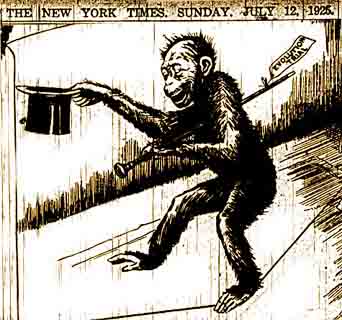
"... that it shall be unlawful for any teacher in any of the Universities, Normals and all other public schools of the State which are supported in whole or in part by the public school funds of the State, to teach any theory that denies the story of the Divine Creation of man as taught in the Bible, and to teach instead that man has descended from a lower order of animals." -Butler Act, 1925 (Tennessee).
This is the law passed in Tennessee in which teacher John Scopes was put in prison for. His case, often referred to as the "Scopes Monkey Trial", was taken to court, defended by Clarence Darrow, and prosecuted by William Jennings Bryan. The problem was, however, that John Scopes never violated this law by teaching evolution from a textbook in his biology class, and therefore it was unfair for him to be put in jail, and unnecessary for the trial to have happened at all.
The two lawyers were well known in the time. Bryan was a three time Democratic candidate for President, but he never succeeded to be elected. He prided himself in being a leader of a Fundamentalist movement that was working to ban Darwin's theory from the classrooms. In the state of Tennessee's eyes, he was the perfect man for the prosecution. Clarence Darrow was nearly opposite of his widely acclaimed opponent. He was well known as a brilliant man, but many worried that his agnostic beliefs would give the prosecution a reason to believe he was biased against the charges against Scopes (Linder, An Introduction).
Bryan used the Bible in many of his cross examinations of Scopes' students and in his other statements. But when Darrow brought his first witnesses, seven scientists in the fields such zoology, in hopes that they would explain how evolution didn't necessarily go against Christian teachings, the prosecution objected, and it was sustained. So Darrow then called his opponent, Bryan, to the stand, as an expert on the Bible, since his experts on evolution were not allowed to testify, and proceeded to ask him a series of questions, quoting from both the Holy Book and Darwin's Origin of Species. Many newspapers such as the New York Times described to their readers how Bryan stumbled over his words multiple times because of the rapid interview and hard points delivered by Darrow. Unfortunately for the defense, the counsel decided to erase all of this interview, ruling that it was not relevant to the trial (Linder, An Introduction).
The verdict was passed on July 21, and John Scopes was found guilty as charged, and fined $100, which with the current inflation rate would translate to $1141.88 (Friedman, Inflation). Upon hearing the jury's decision, Scopes has this to say; "Your honor, I feel that I have been convicted of violating an unjust statute. I will continue in the future, as I have in the past, to oppose this law in any way I can. Any other action would be in violation of my ideal of academic freedom--that is, to teach the truth as guaranteed in our constitution, of personal and religious freedom. I think the fine is unjust" (Scopes, World's). But ironically, there is evidence in the Bible to suggest that Scopes did not oppose this law at all.
The Butler Act clearly states that any theory that denies the story of the Bible is to be outlawed from being taught in the classroom. But the jury and the prosecution obviously didn't know what evolution was about, and if they had, evidence from their very own Bible would have supported it. Take the story of The Parable of the Talents (Matthew 25:14-19) for example. In this, it is described how the Lord gave each of three men his talents; one was given five, one was given two, and one was given a single talent. One traded his five talents and gained five more. Another traded his two and gained two more. But the last one buried his one talent and so did not gain anything. The two who traded and gained more talents were commended by the Lord and given land to prosper on. But the man who did not gain another talent was stripped of the original and given to the man with ten talents. "For to everyone who has, more will be given, and he will have abundance; but from him who does not have, even what he has will be taken away." (Matthew 25:29)(God, Holy). Now take into consideration one of the main points of evolution, survival of the fittest. This phrase means "The idea that species adapt and change by natural selection with the best suited mutations becoming dominant" (Martin, The Phrase). Does this idea not go hand in hand with the story "The Parable of the Talents"? The men who gained more talents (mutations) prospered (survived), while the man who did not build off of his talents (did not mutate/adapt) did not. In just that one story, it seems that evolution does in fact compliment the Bible.
Another idea in the theory of evolution is that of population genetics, such that :generation-to-generation change in the frequencies of alleles within a population that shares a common gene pool" . (Definition: alleles-any of the alternative forms of a gene that may occur at a given locus) (Definition: locus- the place where something is situated or occurs)(Merriam-Webster). More simply, it is how certain genes are passed down, and the more dominant ones tend to continue passing down, while others fail. In the story of Jacob's agreement with Laban (Genesis 30: 25-43)(Till, Gen), Jacob's father-in-law, Laban, agrees to let Jacob tend to his flock and allow Jacob to have all the striped, spotted, and speckled goats. But Laban puts all such goats in his sons' care, three days away from the place where Jacob is tending the other goats, who were all white, therefore hoping to ensure that Jacob gets no goats out of the exchange. But Jacob puts rods that are speckled, spotted, and striped near the watering troughs where the white goats would mate. And so they bore kids that were speckled, spotted, and striped. (God, Holy). This story goes along nicely with the idea of population genetics, as it is believed that "visual stimuli can have prenatal effects on the offspring of breeding animals",(Till, Gen) thus explaining how Jacob went about his little scheme. Once again, it is proved that evolution is not denying the stories of the Bible, it only elaborates and explains the things we have read about for ages in our Holy Book.
The Scopes Monkey Trial was widely publicized at the time, drawing audiences from all over the country into the trial. And although John Scopes was found guilty, many Americans remained on his side. The Butler Act was repealed in Tennessee in 1967, 42 years too late to help Scopes' case. But even without it being invalidated, John Scopes should never have been arrested, as it has been proved with the evidence that the theory of evolution actually supports the divine creation theory in many ways, because he never taught a theory denying the teachings of the Holy Bible.
Wednesday, February 10, 2010
Land of the Lard

First Lady Michelle Obama has started her fight against childhood obesity. "I would move heaven and earth to give my kids all the chance in the world for them to be at the top of their game in every way, shape and form," Mrs. Obama told USA Today. "Let's Move operates under the principle that every family wants the same thing for their kid. So we're going to figure out how to make it easier for them to get it.
Her husband, the president, has decided to help her along by creating a task force on obesity, whose members, according to the Washington Post, "including the secretaries of health, agriculture, education and the interior, must report back within 90 days."
Isn't that great? I mean, obesity is one of the biggest (hah) health issues facing our country today.
Unfortunately, it's not gonna work. Jamie Oliver, a UK celebrity cook, started a reality show this year called "Jamie Oliver's Food Revolution", where he plans on spreading the doctrine of healthy eating to the world. Unfortunately, it's not all rainbows and butterflies in the US.
According to SlashFood.com, "More than half the residents in Huntington are obese, but that doesn't mean they were receptive to help or advice from the British celebrity chef about how to eat better. Many refused to listen or participate during filming of the series.
"They don't understand me. They don't know why I'm here," the 34-year-old Oliver said, sobbing."
West Virginia made a celebrity chef cry because they are so adverse to healthy eating. This is a fight that's going to take a lot of effort, which frankly I don't think is our priority right now. You know why people are fat? They choose to ignore nutrition facts and other blatant health risks of eating McDonalds every night. No amount of "attention" is going to stop people from being lazy.
"Some of her initiatives, such as tax breaks for grocery stores to move into poorly served communities, will require congressional action." -Washington Post.
Congress has bigger things to worry about. Like the recession, rising unemployment rates, and the "war" on "terror". Acknowledgment of this problem is fine, and it's Michelle Obama's own initiative to pursue such acknowledgment is fine with me. But don't bring in the lawmakers. They're already biting off more than they can chew.
Tuesday, February 9, 2010
Speaking of Sanctions...

I know. I know. It's gonna get old fast. But that's ok. I have ammunition!
Another thing I recently learned about sanctions is that they're counter-productive.
Sanctions are meant to reverse a foreign government’s policies. When the end result of a sanction is worse than the original scenario, it is counter-productive.
In addition, sanctions often cause “flag-rallying” among the citizens of the target country. Jay Gordon of the Social Science Research Council (2004) reiterates this idea stating that “when the population at large is subject to deprivation by a foreign nation, they respond to it as they would a form of attack, with increased nationalism and support of their political leadership. Thus, while the intent of the nation imposing the sanctions might be to “send a message” of the wrongfulness of the target state’s actions, the effect is to consolidate support for the leadership, and its legitimacy is enhanced rather than undermined.”
This “flag rallying” effect is not purely hypothetical, however. According to Hufbauer, Shott, and Elliot of the Washington Institute for International Economics (1990), “a nationalistic reaction [to sanctions] seems to have blunted the League’s actions against Italy in 1935-36, Soviet sanctions against Yugoslavia in 1948-55, US measures against Indonesia in 1963-66, UN actions against Rhodesia in 1965-79, and US sanctions against Nicaragua in the 1980s.”
I don't understand how someone could think that sanctions would make the people of these countries go "oh, hey. I no longer have food or clean water, but gosh, my government sucks and I should revolt! GOD BLESS AMERICA!"
Really? Really. Come on, federal government. Let's think about this.
Subscribe to:
Posts (Atom)